

This explains why a time off request for the current cycle may trigger a negative balance alert for a future cycle (not the current one).
When employees request time off for the current cycle and see a warning that they are exceeding the allowed balance limit despite still having enough balance - this alert is referring to the following cycle.
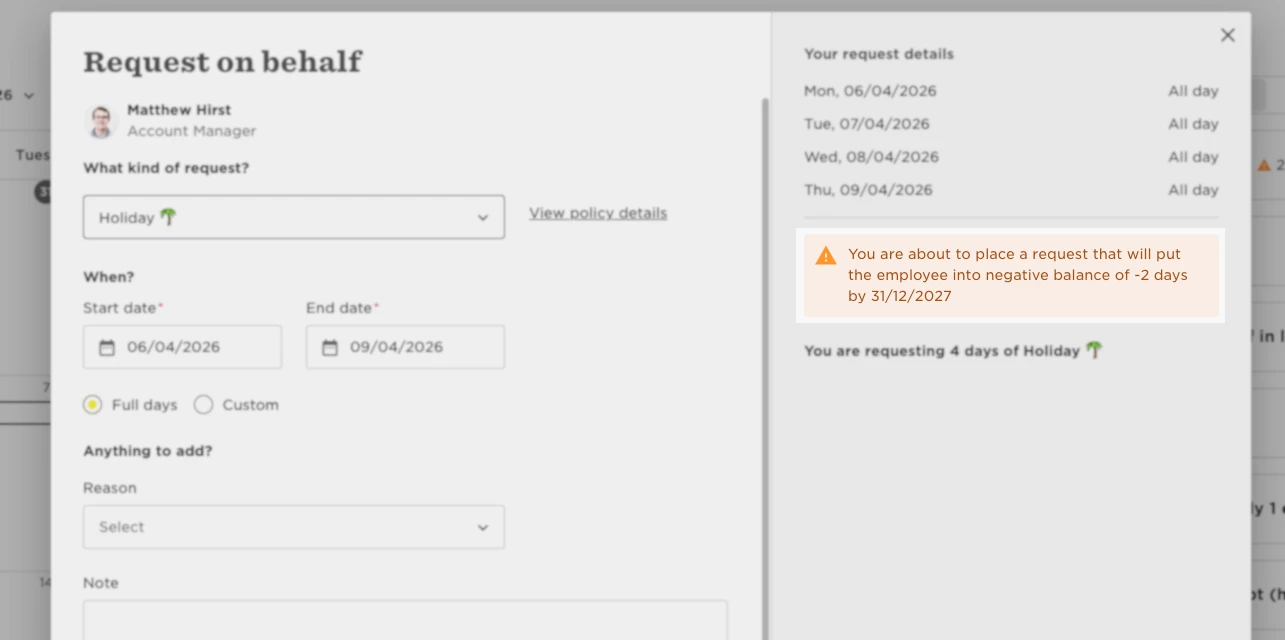
When managers/admins request time off on behalf of an employee, they might see a warning that the request will result in a negative balance by the end of the next cycle (Managers and Admins can put employees into negative balance despite policy settings).
Here’s what’s going on behind the scenes:
-
This happens when your policy allows carryover between cycles.
-
The system already accounts for time off you’ve requested in the upcoming cycle.
-
Those future requests rely on the balance expected to carry over from the current cycle.
-
If you now use more time from your current cycle, the amount left to carry over decreases.
-
As a result, your future cycle may no longer have enough balance to cover those existing requests, triggering the alert-
For example:
-
(In 2026) If your cycle runs Jan–Dec 2026, and you’ve already booked time off in 2027, those requests may depend on unused days carrying over from 2026. If you submit another request in 2026, reducing what can carry over, the system recalculates and shows that by Dec 31, 2027, your balance would be negative.
-
The same logic applies to non-calendar cycles (e.g., April–March). The alert always reflects the end of the following cycle, where the impact becomes visible.
Below are two demonstrations: one when managers/Admins request on behalf, another when the employee does their own request.
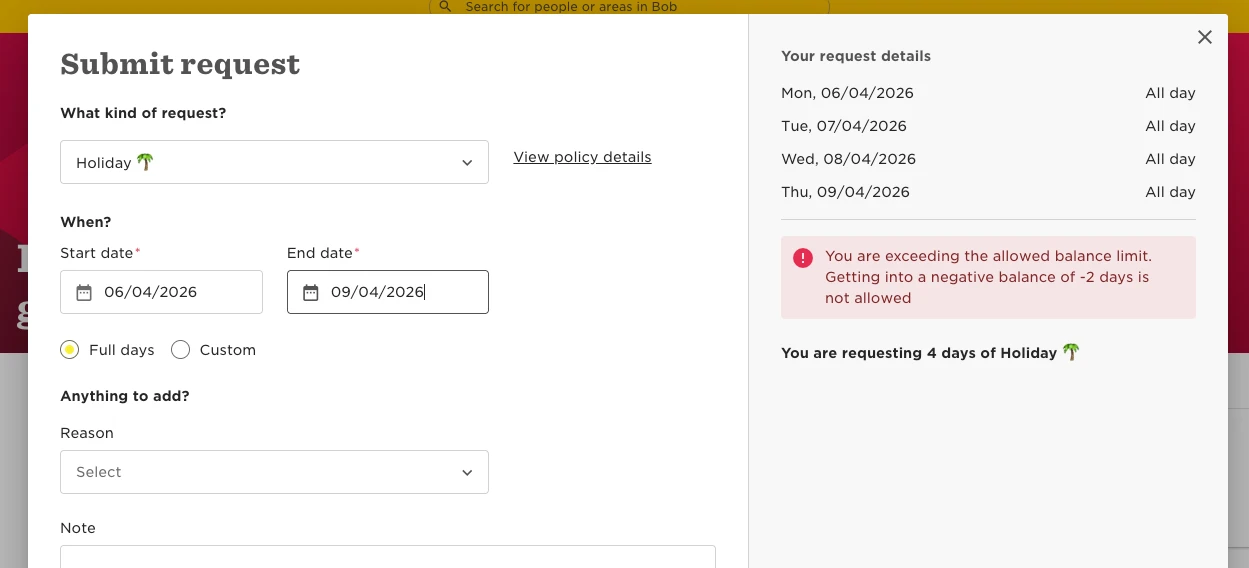
For the employee, it won't be able to proceed. They will need to adjust their future requests (perhaps the ones falling on the future cycle) in order to have enough balance.
Managers/Admins can still go ahead and submit the request. The alert is there to help you understand the impact; future requests or balances can be amended later.